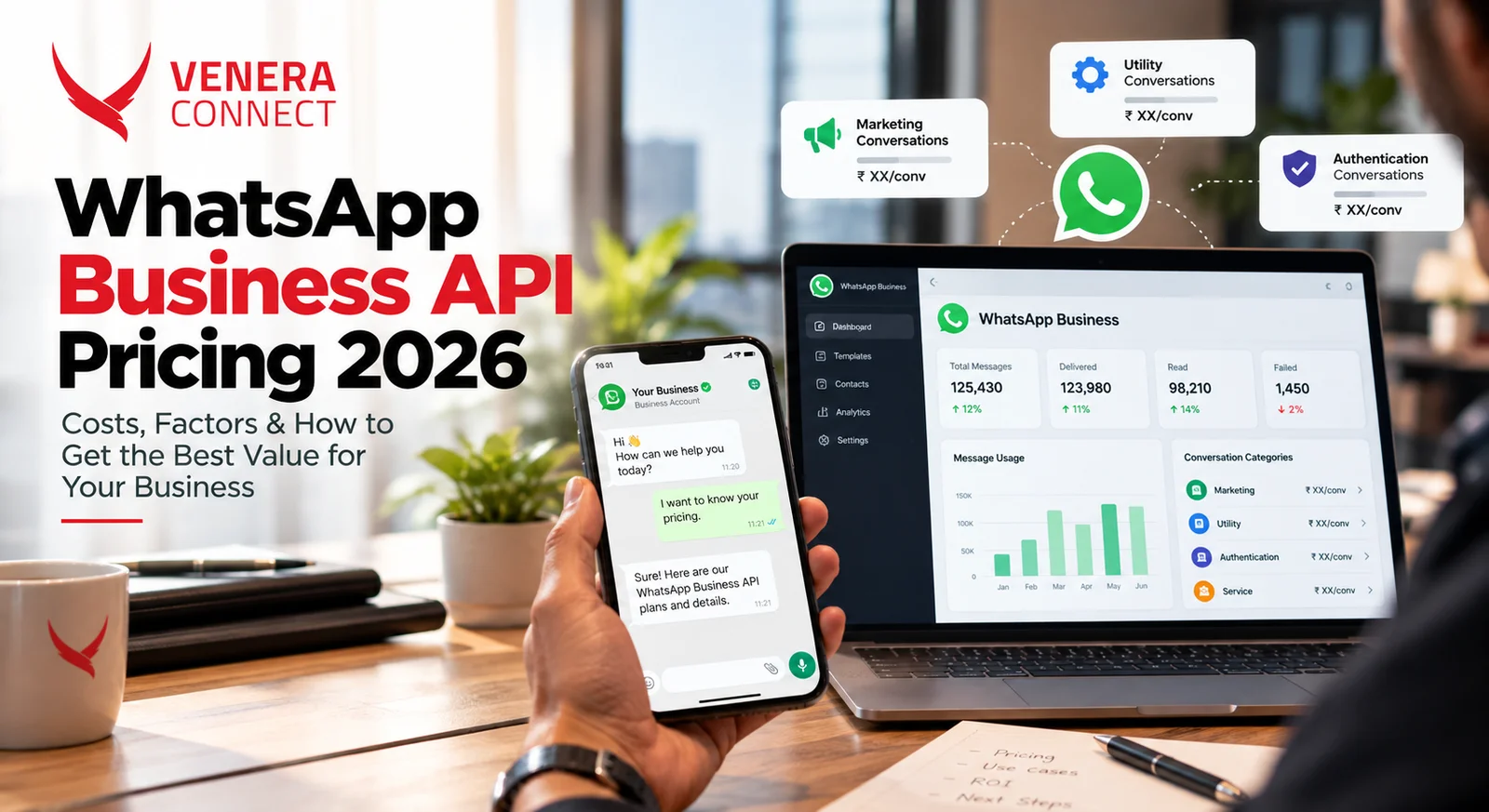
If your business runs customer support, order updates, OTPs, or promotions over WhatsApp, the ground shifted under you this year. WhatsApp has been moving away from the old conversation-based pricing model — where you paid once for a 24-hour conversation window regardless of how many messages passed inside it — toward per-message billing for large parts of the ecosystem, with the most consequential change taking effect around 1 October 2026. Here is what WhatsApp Business API pricing looks like now and how to plan for it.
For a channel that most Indian businesses now treat as mission-critical — order confirmations, delivery updates, appointment reminders, OTPs, support threads. A pricing model change isn’t a footnote. It changes unit economics, forecasting, and in some cases which messages you choose to send at all. Here’s what actually changed, what it means in practice, and how to keep your WhatsApp spend under control without cutting the conversations that drive revenue.
What Changed in WhatsApp Business API Pricing
Since 2022, WhatsApp Business Platform pricing was built around conversation categories, Marketing, Utility, Authentication, and Service, where a business paid a flat rate to open a 24-hour conversation window in a given category, and every message inside that window (from either side) was effectively “free” once the window was open.
The 2026 shift moves a meaningful share of that volume to per-message pricing, primarily affecting:
- Utility messages sent outside an active free-entry-point window (order updates, delivery notifications, payment confirmations)
- Marketing messages, where WhatsApp had already been tightening the definition of what counts as “free-form” versus template-based
- Service conversations initiated by the business after the customer-initiated free window closes
Authentication (OTP) messages remain a separate, tightly metered category, but they haven’t been immune to scrutiny either.
The practical effect: businesses that used to send five, ten, or twenty updates inside a single paid-for conversation window are now often billed per message for volume that falls outside the narrower free windows WhatsApp defines. High-frequency senders, logistics, e-commerce, BFSI, healthcare reminders, feel this the most.
Why WhatsApp Made the Change
WhatsApp’s own reasoning, as laid out in its Business Platform documentation, centers on two things: aligning price with actual usage (a business sending one update pays less than one sending twenty), and closing the gap that let some senders stretch a single paid conversation window to cover disproportionate messaging volume. For WhatsApp, per-message billing is more predictable to model and harder to game. For businesses, it means the era of “pay once, message freely for 24 hours” is ending for a growing share of use cases.
WhatsApp Business API Pricing: The New Cost Math
Exact per-message rates vary by market, message category, and template type, and WhatsApp updates them from its official Business Platform pricing pages rather than through third parties. So always check the live rate card in WhatsApp Manager or your CPaaS provider’s billing dashboard before budgeting, rather than relying on a number that may already be stale by the time you read it.
What matters more than the exact rupee figure is the shape of the change:
- Low-frequency senders are largely unaffected. A business sending one confirmation and one delivery update per order still looks similar to before.
- High-frequency senders see the biggest swing. If you were sending 8–10 utility messages inside one conversation window (order placed, packed, shipped, out for delivery, delivered, payment received, review request, re-engagement), you’re now paying for volume you used to get bundled.
- Marketing sends need tighter targeting. Blast campaigns to broad, unsegmented lists become measurably more expensive per incremental message, which rewards segmentation and personalization over volume.
- Authentication messages stay the most predictable line item, since OTP volume is inherently tied to real user actions (login, checkout, password reset) rather than business-initiated outreach.
How Businesses Are Responding to WhatsApp Business API Pricing
Talking to teams that run WhatsApp at scale, three adjustments come up repeatedly:
Consolidating notifications. Instead of five separate order-status pings, brands are combining updates into fewer, richer messages. A single message with a tracking link and expected delivery window instead of a ping at every logistics checkpoint.
Segmenting marketing harder. Broad promotional blasts are being replaced with smaller, higher-intent segments, cart abandoners, repeat buyers, high-AOV customers, where the cost per message is easily justified by the expected conversion.
Shifting non-urgent updates to lower-cost channels. This is where an omnichannel approach earns its keep: a shipment “out for delivery” notice might go over SMS or RCS, while WhatsApp is reserved for the moments that benefit most from rich media, buttons, and two-way conversation — order confirmation, support, and post-purchase engagement. No channel is inherently “better”; the right channel is the one that matches the message’s urgency, richness, and cost profile.
Auditing templates for approval efficiency. Because failed or rejected template sends still cost time (and sometimes money) to fix, businesses are consolidating overlapping templates and tightening copy to reduce rejection rates.
A Practical Checklist Before 1 October (and After)
- Pull your last 90 days of WhatsApp messaging data and tag each message by category (marketing, utility, authentication, service).
- Identify your top 10 highest-volume message types and estimate their cost under per-message billing versus the old model.
- Look for messages that can be merged (multiple status updates into one) without hurting the customer experience.
- Re-segment marketing lists by actual response/conversion data, not just “everyone who opted in.”
- Confirm your provider’s dashboard reflects live WhatsApp Business Platform rates — don’t budget off a number more than a few weeks old.
- Map which notifications truly need WhatsApp’s rich formatting versus which are fine as SMS or RCS.
Always confirm current rates on Meta’s official WhatsApp pricing page. For help modelling your costs, explore our WhatsApp Business solution.
Frequently Asked Questions
Did WhatsApp Business API pricing change for everyone, or only certain message types?
The shift to per-message billing mainly affects Utility and Marketing messages sent outside the narrower free-entry windows. Authentication (OTP) pricing follows its own, separate structure. Always confirm current rates for your specific country and category in WhatsApp Manager.
Is WhatsApp still worth it after the pricing change?
For the messages that benefit from WhatsApp’s read rates, rich media, and two-way conversation, order confirmations, support, post-purchase engagement, yes. The change mostly penalizes low-value, high-volume messaging, which is exactly the kind of traffic that should move to a cheaper channel anyway.
How can I avoid overspending on WhatsApp notifications?
Consolidate multiple status updates into fewer, richer messages; segment marketing sends by intent rather than blasting full lists; and route low-urgency updates to SMS or RCS where per-message costs are typically lower.
Does this affect OTP and authentication messages?
Authentication pricing is a separate category from Marketing and Utility, and tends to move independently. It’s still worth monitoring, since OTP volume scales directly with your user base and any rate change there has a direct, hard-to-avoid cost impact.
Where can I check the current official rates?
WhatsApp publishes live pricing on its own Business Platform documentation, and your CPaaS provider’s billing dashboard should mirror those rates in your local currency. Treat any third-party number you read as directional, not final.
Businesses running WhatsApp, SMS, RCS, and voice through a single API layer can shift volume between channels as pricing changes, instead of rebuilding integrations every time a platform updates its rate card. If you want a breakdown of how your specific message mix would be affected by the October pricing update, Venera Connect’s team can run the numbers against your last quarter of sends.