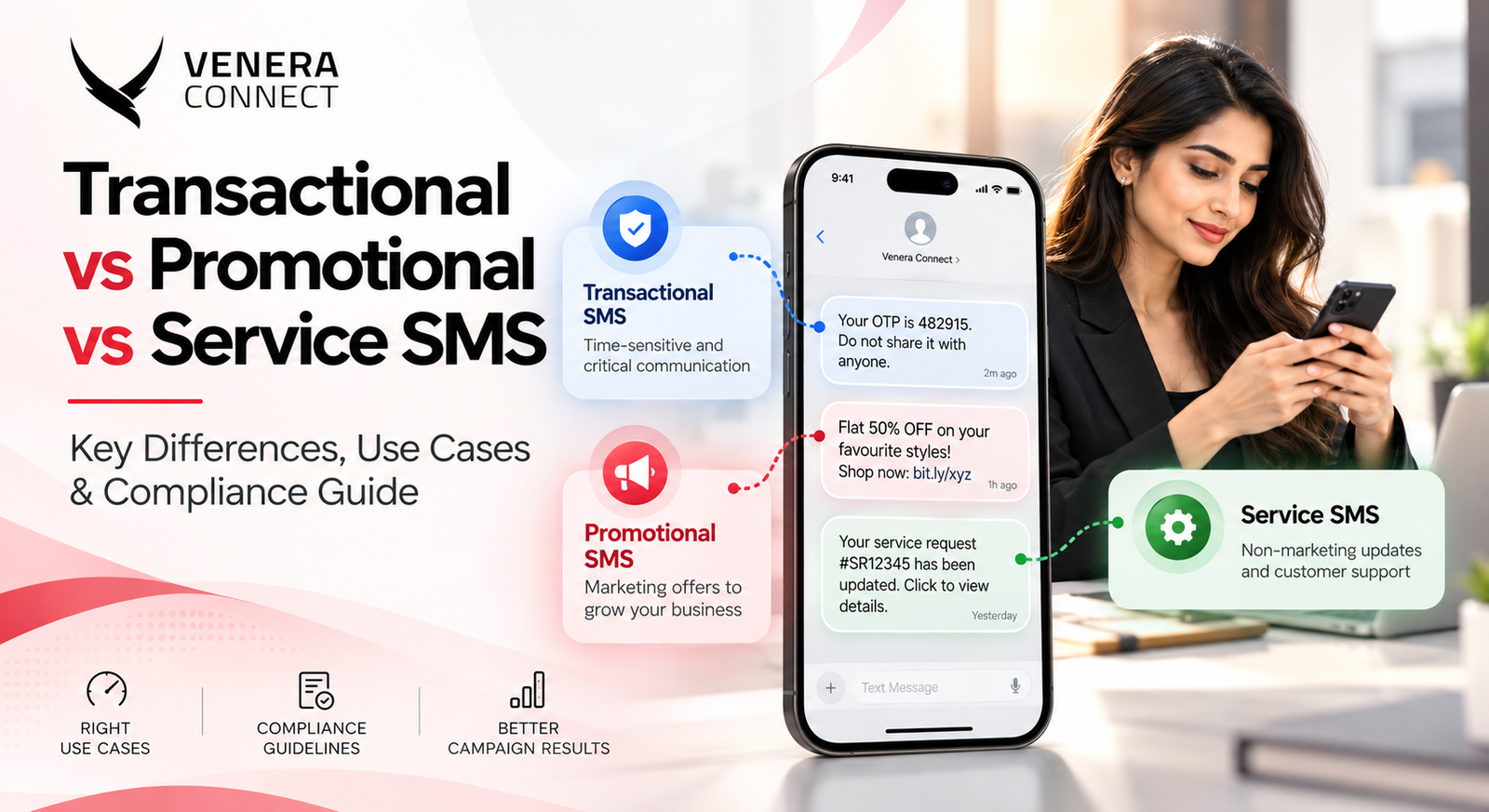
Sending an SMS in India is not as simple as typing a message and hitting send. In fact, every commercial SMS must travel on the right category, use a registered header and match a pre-approved template. Pick the wrong one and your message may be blocked, delayed until morning or rejected by operators. The most common confusion is transactional vs promotional SMS, with service messages sitting somewhere in between. This guide explains how each category works, when to use it and how to stay compliant.
Why Transactional vs Promotional SMS Categories Exist
India’s telecom regulator, TRAI, created a framework to protect consumers from unwanted commercial communication while ensuring essential messages such as OTPs and bank alerts always get through. Specifically, under this framework, run on DLT (Distributed Ledger Technology) platforms operated by telecom operators, every business must register itself, its sender IDs (headers), its message templates and, where required, customer consent. Categories determine who can receive a message, when and with what rules.
Transactional, Service and Promotional SMS Categories
1. Transactional SMS
Firstly, transactional messages are critical, time-sensitive communications that a customer needs to complete or secure a transaction. In particular, under current DLT rules this category is primarily meant for OTPs and similar authentication messages sent by banks and other regulated entities, and for essential transaction information.
- Examples: One-time passwords, debit or credit alerts, payment confirmations
- DND: Delivered even to numbers registered on the Do Not Disturb list
- Timing: Can be sent 24×7
- Content: Must not include any promotional content
2. Service SMS
Secondly, service messages are communications related to a product or service the customer already uses. Moreover, they come in two types:
- Service Implicit: Messages that are a natural part of the customer relationship and do not need separate explicit consent. Examples: order confirmations, delivery updates, booking confirmations, appointment reminders, account statements, OTPs for non-bank businesses.
- Service Explicit: Messages that need the customer’s explicit consent, recorded on the DLT platform, because they go beyond the core transaction. Examples: renewal offers or cross-sell messages sent to existing customers who have opted in.
In short, service Implicit messages can reach DND numbers and can be sent round the clock. In contrast, service Explicit messages rely on the consent the customer has given.
3. Promotional SMS
Finally, promotional messages are marketing communications meant to sell or promote a product, service or offer.
- Examples: Discount offers, sale announcements, new product launches, event invitations
- DND: Not delivered to customers who have blocked promotional communication in the relevant category
- Timing: Restricted to the permitted daytime window (generally between 10 a.m. and 9 p.m.)
- Sender ID: Promotional messages use numeric headers rather than alphabetic brand names
Transactional vs Promotional SMS: Quick Comparison
| Feature | Transactional | Service Implicit | Service Explicit | Promotional |
|---|---|---|---|---|
| Purpose | OTPs, critical transaction alerts | Updates on existing service | Consented offers to customers | Marketing |
| Reaches DND numbers | Yes | Yes | Yes, with consent | No (as per preferences) |
| Delivery hours | 24×7 | 24×7 | As per consent rules | Daytime window only |
| Sender ID | Alphabetic header | Alphabetic header | Alphabetic header | Numeric header |
| Consent needed | No separate consent | No separate consent | Yes, explicit | Required for DND users |
How Header Suffixes Help Customers
To help customers instantly recognise what kind of message they are receiving, sender headers in India now carry a category suffix, such as -P for promotional, -S for service, -T for transactional and -G for government messages. As a result, this makes it easier for customers to trust genuine service alerts and identify promotions. Therefore, make sure your registered headers and templates line up with the category you are actually using.
Transactional vs Promotional SMS: How to Choose
So ask three questions about every message:
- Is it essential to complete or secure a transaction? If it is an OTP or critical alert, it belongs in the transactional or service implicit category.
- Is it about a product or service the customer already has? If yes and it is purely informational, use service implicit.
- Finally, does it try to sell something? If yes, it is promotional, or service explicit if the customer has given explicit consent.
Also, a useful test: if you removed the message, would the customer’s experience of something they already bought break? If yes, then it is likely a service message. Otherwise, it is probably promotional.
Transactional vs Promotional SMS Mistakes to Avoid
- Adding offers to service templates: “Your order is shipped. Use code DIWALI20 for 20% off your next order” mixes categories and can be rejected.
- Template mismatch: Changing fixed text in a registered template, even slightly, causes scrubbing failures.
- Unregistered URLs or numbers: Links, call-back numbers and app links in messages must be whitelisted on DLT.
- Wrong header for the category: Using a promotional header for service messages or vice versa.
- Ignoring time windows: Promotional messages scheduled at night are held or dropped.
For a complete compliance checklist, read TRAI’s DLT and consent rules in 2026.
Where Other Channels Fit In
However, SMS categories are specific to SMS. Instead, other channels have their own categorisation. For example, WhatsApp classifies templates as marketing, utility or authentication, and RCS has its own template approval process. Meanwhile, many businesses use SMS for universal-reach alerts and OTPs, alongside WhatsApp or RCS for rich, interactive updates. For authentication specifically, see our comparison of SMS, WhatsApp and voice OTP.
Transactional and Promotional SMS Examples by Industry
Finally, here is how different businesses typically map their messages to categories. Use these as a starting point and confirm the exact category during template registration.
E-commerce and D2C
- Login OTP: service implicit
- Order confirmation and shipping update: service implicit
- Cash-on-delivery confirmation request: service implicit
- “Our end-of-season sale is live”: promotional
- Personalised offer to an opted-in customer: service explicit
Banking and NBFCs
- Transaction OTP and debit alert: transactional
- EMI due reminder: service implicit
- Pre-approved loan offer: promotional, or service explicit with recorded consent
Healthcare
- Appointment confirmation and reminder: service implicit
- Lab report ready notification: service implicit
- Health check-up package offer: promotional
Education
- Fee due reminder and exam schedule: service implicit
- Admission open announcement to new prospects: promotional
Sample Transactional and Promotional SMS Templates
Good templates are short, clear and keep variables in predictable places. Variables are marked here as {#var#}, the placeholder format used on DLT platforms.
- Service implicit: “Your order {#var#} has been shipped and will arrive by {#var#}. Track here: {#var#} – BRAND”
- OTP: “{#var#} is your OTP to log in to BRAND. Valid for 10 minutes. Do not share it with anyone.”
- Promotional: “Festive offer: flat {#var#} off on {#var#} till {#var#}. Shop now: {#var#} T&C apply. To opt out, reply STOP.”
Keep the fixed text identical in every send, and make sure any URL you place in a variable is on your whitelisted list.
The categories come from TRAI regulations, so check its site for the latest rules.
Frequently Asked Questions
Can I send an OTP as a service message?
Yes. For many non-banking businesses, OTPs are commonly sent through the service implicit category. Banks and regulated financial entities typically use the transactional category.
Why are my promotional SMS not reaching some customers?
Customers who have registered DND preferences for the relevant category will not receive promotional messages, and promotional messages sent outside the permitted time window are not delivered.
Do I need separate templates for each category?
Yes. Each template is registered against a specific category and header, and messages must match the registered template exactly, apart from the variable fields.
Is service explicit consent the same as a checkbox on my website?
Not necessarily. Explicit consent for service explicit messages must be captured and verified in line with the DLT consent framework. Talk to your provider about digital consent acquisition options.
Send the Right SMS, Every Time
Venera Connect helps businesses register headers and templates, choose the right routes and monitor delivery in real time. Explore our SMS solution or talk to our team to set up compliant, reliable SMS for your business.