For years, a business text message in India has meant one thing: a plain grey SMS from a random alphanumeric sender ID, easy to mistake for spam and easier still to ignore. That’s changing — quietly, on the same phones your customers already carry.
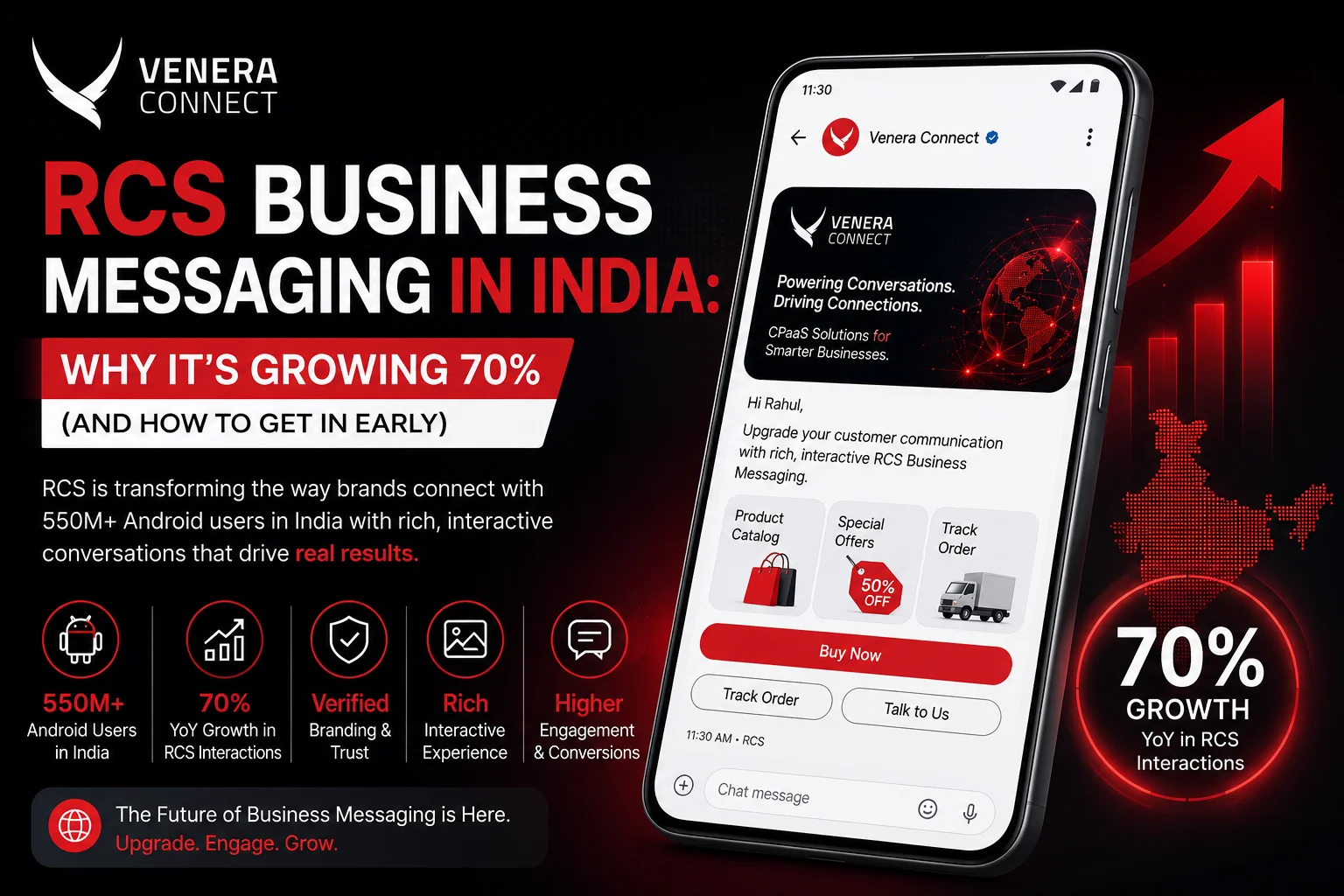
Rich Communication Services, or RCS, is now the default messaging experience on the majority of Android phones in India, and businesses are starting to notice. Industry data published this year puts the growth of RCS interactions in India at 70% year-over-year. Meanwhile, the user base now touches roughly 550 million people. That’s not a niche channel anymore. That’s mainstream reach, and most brands haven’t caught up to it yet.
What Is RCS, Exactly?
Think of RCS as SMS’s replacement, not its cousin. RCS messaging runs through the default messaging app already installed on an Android phone, no app download, no extra step for the customer, but it looks and behaves like an actual brand conversation rather than a wall of grey text.
With RCS, a business can send:
- A verified sender name and logo instead of an anonymous number or header
- Images, video, and rich media inside the message itself
- Carousels customers can swipe through, like a mini product catalog
- Buttons for actions — “Buy Now,” “Track Order,” “Book a Slot” — that customers can tap without leaving the chat
- Suggested quick replies that speed up the back-and-forth
For a customer, it barely feels like a text message. For a business, it’s a fully branded storefront sitting inside the one app every Android user already opens dozens of times a day.
The Numbers Behind the Shift
The growth isn’t even. Instead, it clusters in a handful of industries that got in early and already see the payoff. Marketing and advertising has been the standout. In fact, RCS adoption in that category rose close to 2,900% over the past year, according to the same industry data. Retail and e-commerce, finance and fintech, and real estate follow close behind, all leaning on RCS for exactly the kind of rich, visual, action-oriented messaging that plain SMS never supported.
What ties these industries together is simple: they all need customers to do something after reading a message, buy, browse, confirm, pay. RCS turns that into a single tap instead of a jump to another app or website.
For everyone else, this is still an open window. Most Indian businesses are still sending plain-text SMS by default. As a result, the brands moving to RCS now are getting a head start with very little competition for attention in the format.
Why It Beats Plain SMS on Engagement
Two things make RCS fundamentally different from SMS, and both come down to trust and attention.
Verified branding. An RCS message arrives with your business name, logo, and a verified badge. Not a cryptic six-character header that could belong to anyone. In a country where SMS spam and phishing are a daily nuisance, that verification alone changes how people read a message.
A richer, more actionable format. A carousel, a product image, or a “Pay Now” button inside the chat gives customers a reason to engage on the spot, instead of reading a line of text and moving on. Businesses consistently see meaningfully higher engagement on RCS campaigns compared to standard SMS blasts.
And because RCS gracefully falls back to plain SMS on devices that don’t support it, businesses don’t have to choose one channel over the other. A well-built RCS strategy simply upgrades the experience wherever it’s available, without dropping anyone.
What You Can Actually Do With RCS
The use cases go well beyond “nicer-looking promotions.” Businesses are already using RCS to:
- Turn browsing into buying — interactive product catalogs and carousels let customers compare and select items right inside the chat
- Automate customer service — RCS-powered chatbots can walk a customer through a problem, offer self-help fixes, and even book an on-site or home visit
- Run loyalty programs — customers can sign up for and manage a loyalty relationship, and redeem points, directly inside the conversation
- Guide customers step-by-step — video-based instructions for installing or using a product, delivered as part of the message
- Drive footfall — personalized mobile coupons that shoppers redeem at checkout
- Keep customers updated — brand and product news delivered as rich, personalized media instead of a plain notification
None of this requires the customer to install anything. It all happens in the messaging app they already use every day.
How to Start: What It Actually Takes
Moving to RCS isn’t a plug-and-play switch — there’s some groundwork involved:
- Sender registration and verification. You must register and verify your business identity (name, logo, brand colors) before your messages carry that verified badge.
- Template and campaign design — you need to build carousels, buttons, and quick replies for each use case, not recycle an old SMS script.
- An RCS-plus-SMS fallback strategy — so customers on non-RCS devices still get the message, just in the simpler SMS format.
This is exactly where most businesses stall. Not because RCS is complicated in principle, but because the registration, verification, and carrier-side setup takes real telecom infrastructure and relationships to navigate.
RCS vs SMS: What’s the Real Difference?
SMS allows only 160 characters of plain text from an anonymous sender ID. RCS messaging runs through the same default app but adds a verified business name and logo, images and video, interactive buttons, and product carousels — while still falling back to plain SMS automatically on phones that don’t support it. For most businesses, that makes RCS the natural upgrade rather than a separate channel to manage.
Where Venera Connect Fits In
This is where having the right technology partner matters. Venera Connect is RCS-ready today, built on a direct partnership with Google and Vodafone Idea. This means the registration, verification, and delivery infrastructure is already in place. Businesses don’t need to negotiate carrier access or figure out the technical setup themselves. Instead, they can go straight to designing the customer experience. The carousels, the buttons, the branded conversations.
If you’re still sending plain SMS to your customers, RCS is the upgrade sitting right in front of you, on a channel your customers already have open. The businesses moving first are the ones shaping what “normal” looks like before everyone else catches up.
Ready to see what an RCS campaign could look like for your business? Get in touch with Venera Connect to begin.