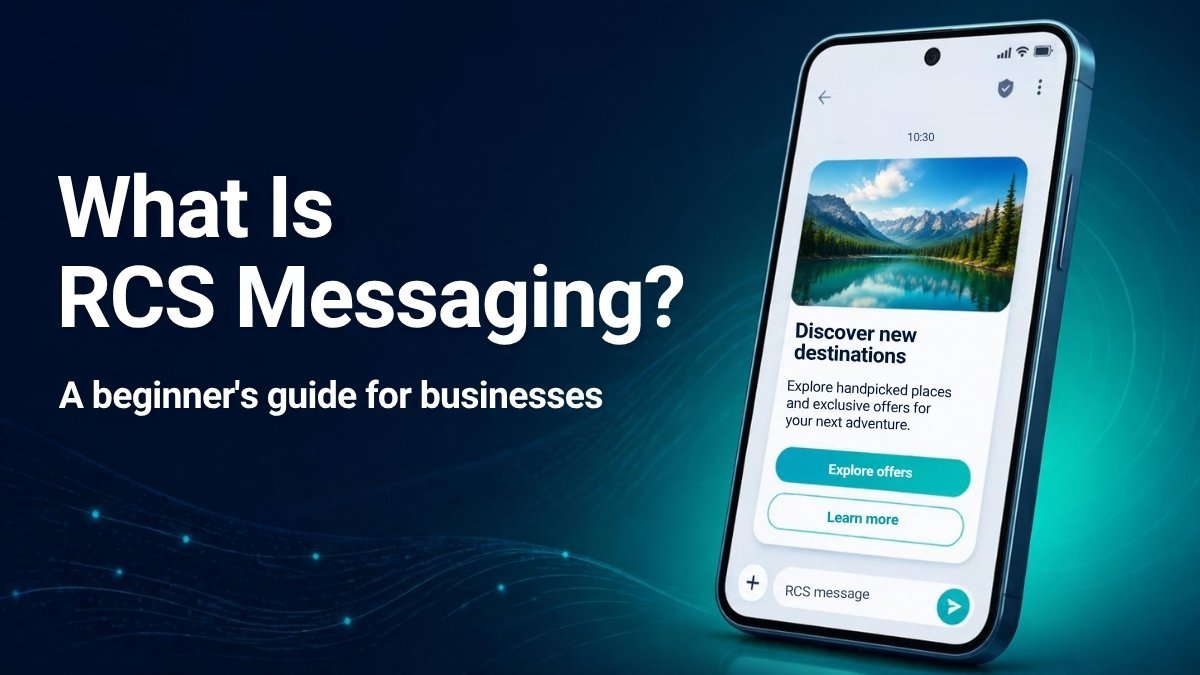
Open the default messaging app on most smartphones today and you may notice something new: messages from brands that carry a logo, a verified badge, product images, swipeable cards and tap-to-reply buttons, all without installing any extra app. That is RCS. If you are wondering what is RCS messaging and whether it belongs in your customer communication mix, this beginner’s guide covers the essentials in plain language.
What Is RCS Messaging?
RCS stands for Rich Communication Services. In short, it is a modern messaging standard, developed by the global mobile industry, that upgrades traditional SMS inside the phone’s native messaging app. However, where SMS is limited to plain text, RCS supports rich media, interactive elements, typing indicators, read receipts and verified sender identity.
For businesses, the relevant flavour is RCS Business Messaging (RBM). In short, it allows brands to send branded, interactive messages to customers directly in the messaging app they already use for texts. Also, there is nothing for the customer to download and no account to create.
How RCS Messaging Works
- Firstly, the brand creates an RCS agent. This is the business’s verified sender profile, with name, logo, colour, description and contact details.
- The agent is verified and launched with mobile operators so customers see an authentic, branded sender.
- Then the business sends messages through an API or campaign dashboard provided by its messaging platform.
- The platform checks capability. If the customer’s phone and network support RCS, the rich message is delivered. If not, a fallback such as SMS can be triggered automatically.
- The customer interacts by tapping buttons, swiping carousels or replying, and those responses flow back to the business in real time.
Key Features of RCS Business Messaging
Branded, verified sender
Messages show your brand name, logo and a verified badge instead of an anonymous header. As a result, this helps customers trust the message and protects against spoofing.
Rich media
Send high-quality images, GIFs, videos and PDFs such as invoices, tickets or brochures.
Rich cards and carousels
Combine an image, title, description and buttons in a single card, or line up several cards in a swipeable carousel to showcase products, plans or offers.
Suggested replies and actions
Add tap-to-reply chips like “Track order” or “Talk to an agent”, and action buttons that open a URL, start a call, show a location on a map or add an event to the calendar.
Two-way conversations
Customers can reply, and the conversation can be handled by a chatbot, a live agent or both.
Read receipts and analytics
See when messages are delivered and read, and track clicks on each button, giving far richer campaign insight than plain SMS.
Why RCS Messaging Is Gaining Momentum in India
- Massive device reach: RCS is supported on most modern Android phones in the default messaging app, and newer iPhones now support RCS as well. Read more about RCS on iPhone in India.
- Operator support: Major Indian operators support RCS, making it a mainstream channel rather than an experiment.
- No app install: Customers receive rich experiences in an app that is already on their phone.
- Trust: Verified branding addresses the growing concern about fraudulent messages.
- Rising engagement: Businesses report stronger read and click rates when messages are visual and interactive. See why RCS business messaging is growing fast in India.
Popular RCS Messaging Use Cases
| Industry | Use case | What the customer sees |
|---|---|---|
| Retail and e-commerce | Product launches, offers, order updates | Carousel of products with “Buy now” and “View more” buttons |
| Banking and fintech | Account alerts, card activation, loan offers | Verified bank sender with a secure “Activate card” action |
| Travel | Booking confirmations, boarding passes, check-in reminders | Rich card with itinerary, map location and calendar button |
| Healthcare | Appointment reminders and reports | Card with doctor details and “Confirm” or “Reschedule” replies |
| Education | Admissions campaigns, fee reminders | Course carousel with “Apply now” and “Call counsellor” buttons |
| Automotive | Test drive bookings, service reminders | Video of the new model with a “Book test drive” action |
Where RCS Fits Alongside Other Channels
However, RCS is not a replacement for any single channel. Instead, each channel plays a role in a healthy communication strategy:
- SMS provides universal reach on every phone and remains the backbone for OTPs and critical alerts.
- WhatsApp is ideal for rich two-way conversations with customers who prefer chatting with brands there.
- RCS brings branded, interactive experiences into the native messaging inbox.
- Voice handles moments that need a human conversation or reach customers who prefer calls.
Many businesses use RCS with automatic SMS fallback, so customers on RCS-capable phones get the rich experience while everyone else still receives the message.
How RCS Messaging Pricing Works
RCS pricing varies by provider and message type. For example, common models include charging per message for simple text messages and a separate rate for rich or interactive messages, or charging per conversation session. When comparing costs, factor in the value of higher engagement and the cost of fallback SMS for customers who are not RCS-reachable.
How to Get Started with RCS Messaging
- Choose a messaging partner that supports RCS Business Messaging in India and offers SMS fallback.
- Prepare brand assets: logo, banner image, brand colour, description, website, phone number and privacy policy link.
- Create and verify your RCS agent through your provider.
- Design your first use case. Start with something simple and high-value, such as an order update or a product carousel for existing customers.
- Get templates approved and test on a range of devices.
- Launch, measure and iterate. Finally, track delivery, read and click rates, and compare them against your other channels.
RCS Message Types Explained
RCS supports several message formats. Knowing them helps you pick the right one for each use case.
- Basic text message: A plain text message from your verified agent, similar to SMS but with branding and read receipts. Good for short updates.
- Rich text message: Text combined with suggested replies or action buttons, such as “Track order” or “Call us”.
- Rich card: A single card with media, a title, description and up to a few buttons. Ideal for a featured product, a boarding pass or an appointment confirmation.
- Carousel: A horizontally scrollable set of rich cards. Perfect for catalogues, plan comparisons or multiple offers.
- Media message: An image, video or document on its own, such as an invoice PDF or a product demo video.
Best Practices for Your First RCS Campaign
- Lead with a strong visual. After all, the image is what stops the scroll. Use high-quality, uncluttered visuals that work on small screens.
- Keep copy short. A clear headline and one or two lines of description are enough.
- Limit buttons. Two or three meaningful actions work better than a crowded card.
- Personalise. Use the customer’s name, city, last purchase or preferred category.
- Plan the conversation. Decide what happens after every tap, including handing off to a human when needed.
- Set up fallback. Write an SMS version of every critical message for customers who are not reachable on RCS.
- Measure beyond delivery. Track reads, button clicks, replies and conversions to understand true performance.
Google’s RCS Business Messaging documentation is the best technical reference for the standard.
Frequently Asked Questions
Do customers need to install an app to receive RCS?
No. RCS messages arrive in the phone’s default messaging app, as long as the device and network support RCS.
What happens if a customer’s phone does not support RCS?
Your platform can automatically fall back to SMS, so the customer still receives the essential information.
Is RCS secure?
RCS Business Messaging uses verified sender profiles, which help customers identify genuine brands and reduce the risk of spoofing. Brands still need to follow good security practices, like never asking customers to share passwords or OTPs.
Can I use RCS for OTPs?
Yes, and many brands are exploring it. Our article on RCS for OTP explores the pros and considerations.
Start Your RCS Journey with Venera Connect
Venera Connect helps Indian businesses launch verified RCS agents, design rich campaigns and set up automatic fallback so every customer is reached. Explore our RCS solution or talk to our team.