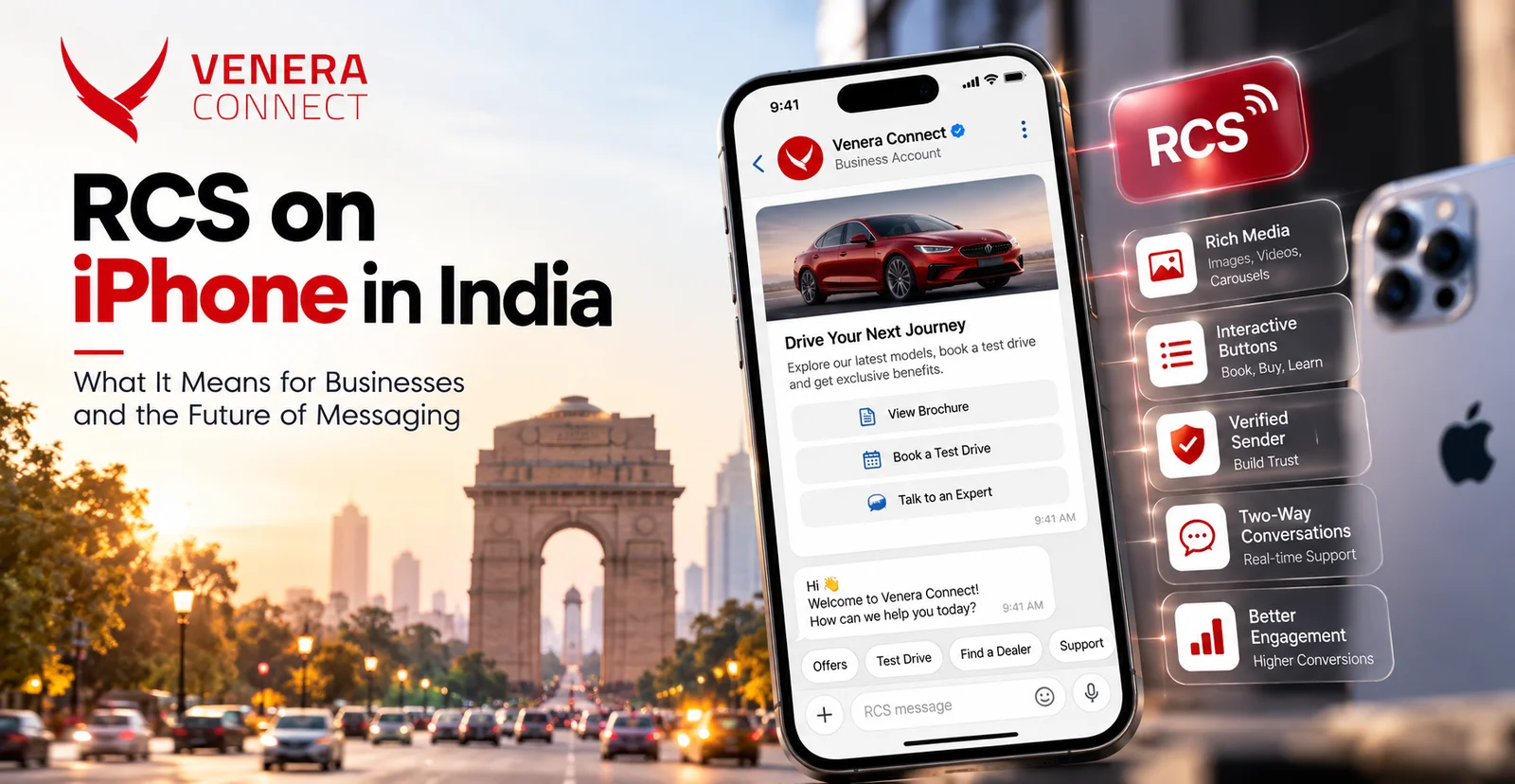
For years, RCS Business Messaging in India had one structural limitation that no amount of feature richness could fix: it only reached Android users. iPhone users. A smaller but high-value, high-spend slice of the Indian smartphone market — stayed reachable only through SMS, WhatsApp, or app push. That changed in 2026, when Jio enabled RCS support for iPhones in India, following Apple’s broader move to support the RCS Universal Profile in its Messages app.
This is a genuinely structural shift, not a minor feature update. And it’s exactly the kind of development worth building a messaging strategy around before your competitors do.
What Actually Happened With RCS on iPhone in India
Apple added RCS (Rich Communication Services) support to the Messages app starting with iOS updates that adopted the GSMA Universal Profile, the same open standard that Android’s Google Messages has used for RCS Business Messaging. In India, this required the telecom operator side to switch on RCS infrastructure and certify interoperability. This is what Jio’s 2026 rollout represents: iPhone users on Jio’s network can now send and receive RCS messages, including branded business messages, natively inside the iPhone Messages app, without installing anything new.
Airtel and Vi have their own RCS rollouts in progress at varying stages of network and device coverage, so reach isn’t universal on day one. But the direction is clear: RCS is becoming a cross-platform channel in India for the first time, the way WhatsApp already is.
Why This Matters More Than It Sounds
Before this rollout, any brand running RCS Business Messaging in India was, by definition, only reaching part of its audience, Android users, while iPhone users on the same customer list fell back to plain SMS, losing the verified sender badge, rich cards, quick-reply buttons, carousels, and read receipts that make RCS worth using in the first place.
With iPhone support live, the same RCS campaign can now reach both platforms with the same rich experience: a verified business name and logo instead of an unknown number, branded rich cards for order tracking or product carousels, suggested-reply chips that turn a notification into a two-tap action, and delivery/read receipts that give real visibility into whether a message landed.
For sectors where the iPhone user base skews disproportionately valuable, BFSI, premium D2C, travel, real estate, healthcare, this closes a real gap in reach that SMS-only strategies couldn’t fill and WhatsApp-only strategies could only partially fill (not every customer has WhatsApp opted in, and not every use case fits WhatsApp’s messaging policies).
RCS vs. WhatsApp vs. SMS: Not a Ranking, a Toolkit
It’s tempting to frame this as “RCS vs. WhatsApp” — it shouldn’t be. Each channel has a role:
- SMS remains the universal fallback — it reaches every phone, on every network, with zero app or opt-in dependency. For OTPs and critical alerts where delivery certainty matters more than rich formatting, SMS is still the right default.
- WhatsApp offers the deepest two-way conversational experience and the largest active user base in India, with the richest support for catalogs, payments, and long-form support threads.
- RCS sits in between: carrier-native (no app install, no opt-in flow required the way WhatsApp needs), now cross-platform, with rich formatting that SMS can’t match and a lighter-weight integration than WhatsApp for many use cases.
The businesses getting the most value from 2026’s RCS expansion aren’t replacing WhatsApp or SMS with RCS. They’re routing each message type to whichever channel fits it best, often using RCS as the fallback when a customer hasn’t opted into WhatsApp but still deserves more than plain text.
What RCS on iPhone in India Means for You Now
Audit your current RCS reach. If you’re already running RCS Business Messaging, check what share of your customer list is now reachable on iPhone through your telecom partner’s rollout. This number will keep climbing as Airtel and Vi expand coverage.
Don’t rebuild content from scratch. RCS campaigns built for Android (rich cards, carousels, suggested replies) work on iPhone under the Universal Profile without redesigning creative — verify rendering, but the underlying rich-card format is standard.
Set explicit fallback rules. For any customer not yet on an RCS-capable device or network, your platform should fall back automatically to SMS so no one drops out of the flow. This is table stakes for any serious RCS deployment, not a nice-to-have.
Get your sender verified early. Verified business identity (name, logo, brand color) is one of RCS’s biggest trust advantages over plain SMS. Verification takes time to process, so start now rather than when a campaign is already planned.
Watch operator coverage, not just device support. Apple supporting RCS is necessary but not sufficient. The customer’s carrier also needs to have RCS switched on and interoperable. Track this by network as it expands through 2026 and 2027.
Google’s RCS Business Messaging documentation explains how verified agents work across devices. To plan your first campaign, explore our RCS messaging solution.
Frequently Asked Questions
Do iPhone users need to install an app to receive RCS business messages?
No. RCS in India works natively inside the built-in Messages app on supported iPhones, the same way it already works in Google Messages on Android. No separate app or download required.
Is RCS available for all iPhone users in India yet?
Not universally. Availability depends on the customer’s telecom operator having RCS infrastructure switched on and interoperable with Apple’s implementation. Jio has rolled this out; other operators are at different stages, so coverage will keep expanding through 2026.
Does RCS replace WhatsApp or SMS for my business?
No. The three channels serve different needs. SMS is the universal, opt-in-free fallback; WhatsApp offers the richest two-way conversation and largest opt-in base; RCS now offers carrier-native rich messaging across both Android and iPhone without requiring an app-based opt-in. Most businesses get the best results routing messages to whichever channel fits the use case.
What do I need to start sending RCS business messages to iPhone users?
A verified RCS sender profile (business name, logo, and brand details go through a verification process) and a messaging platform or API that supports RCS Business Messaging with automatic SMS fallback for unreachable numbers.
Will RCS pricing be similar to SMS or closer to WhatsApp?
RCS business messaging typically sits in its own pricing structure, generally between plain SMS and WhatsApp’s per-conversation or per-message rates, though exact costs vary by provider and message type — check current rates with your messaging platform before budgeting a large campaign.
Because RCS reach still varies by operator and device, any RCS campaign needs a reliable SMS fallback built in from day one. Otherwise you risk silently losing customers who haven’t caught up yet. Venera Connect’s messaging APIs handle that fallback automatically across WhatsApp, RCS, and SMS, so you can launch on the new channel without leaving anyone behind.