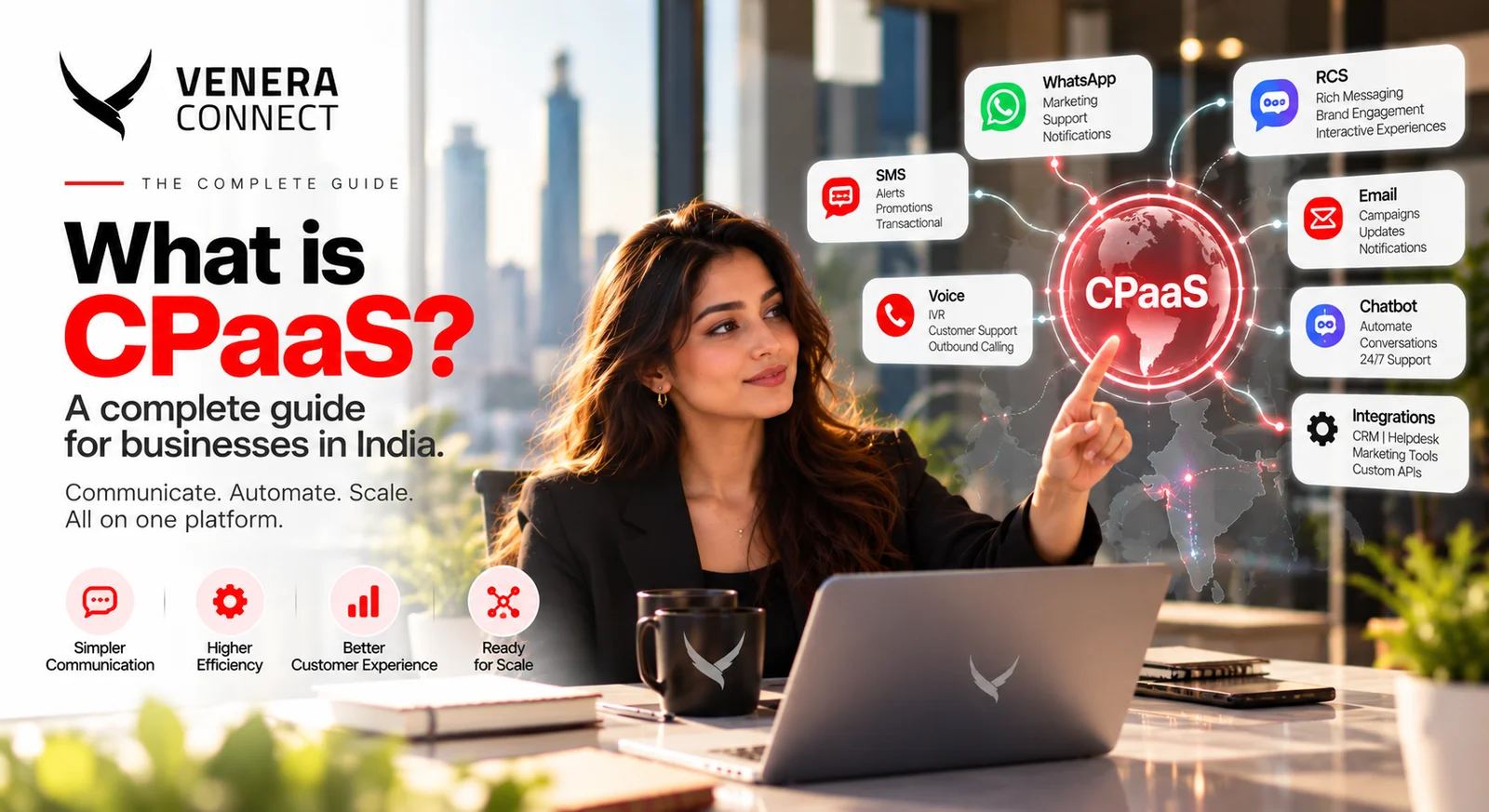
Every business talks to customers. The difference in 2026 is how many places those conversations happen: an OTP by SMS, an order update on WhatsApp, a rich product card over RCS, a delivery call routed through a masked number, and a chatbot answering questions at 2 a.m. However, running all of that through separate vendors, dashboards and contracts quickly becomes expensive and messy. In short, that is exactly the problem CPaaS solves. If you have been asking what is CPaaS and whether your business needs it, this guide walks through the concept, the building blocks, real use cases and how to get started.
What Is CPaaS?
CPaaS stands for Communication Platform as a Service. It is a cloud platform that lets businesses add communication features such as messaging, voice calls and chat automation to their own apps, websites, CRMs and back-end systems using APIs, without building or maintaining any telecom infrastructure themselves.
In other words, think of it the way you think of cloud hosting. For example, you do not buy servers to run a website; you rent capacity from a provider. Similarly, with CPaaS, you do not negotiate with every telecom operator, register with every messaging network or run your own switching equipment. Instead, the provider handles carrier connections, routing, compliance plumbing and scale, and you plug the capabilities into your workflows with a few lines of code or a no-code dashboard.
How CPaaS Works
Generally, at a high level, a CPaaS platform sits between your business systems and the communication networks your customers use.
- Your system triggers an event. Firstly, a customer places an order, requests a login code, misses a payment or fills a lead form.
- Then your application calls the CPaaS API. It passes the recipient, the channel (SMS, WhatsApp, RCS, voice) and the message template or content.
- The platform routes the message. It selects the right carrier or network route, applies compliance checks such as DLT template matching for SMS in India, and delivers the message.
- Finally, responses and delivery reports flow back. Delivery status, read receipts, replies and call outcomes are sent back to your system through webhooks, so your CRM or helpdesk stays updated in real time.
Because everything runs through one platform, you get one set of APIs, one billing relationship, one reporting layer and one support team, no matter how many channels you use.
The Core Building Blocks of a CPaaS Platform
1. SMS
Still, SMS remains the most universal channel in India. Also, it works on every phone, needs no data connection and is the default for OTPs, transactional alerts and time-sensitive notifications. A CPaaS platform handles DLT header and template registration workflows, route selection and delivery reporting. Explore our SMS solution for details.
2. WhatsApp Business Platform
Meanwhile, with hundreds of millions of users in India, WhatsApp is where many customers prefer to talk to brands. Similarly, through the WhatsApp Business Platform, businesses can send approved template messages, run two-way support conversations, share media, collect payments and run chatbots. See our WhatsApp solution.
3. RCS Business Messaging
In addition, RCS (Rich Communication Services) upgrades the native messaging app on the phone with branded sender profiles, verified badges, images, carousels and suggested-reply buttons, with no separate app to download. Learn more on our RCS solution page.
4. Voice
Voice APIs power IVR menus, outbound voice broadcasts, click-to-call, number masking, call tracking and voice OTPs. For many customers, especially in Tier 2 and Tier 3 cities, a call is still the most trusted way to resolve an issue. Our voice solution covers these capabilities.
5. Chatbots and Conversational AI
Also, chatbots automate repetitive questions, qualify leads, book appointments and hand complex conversations to human agents. Moreover, modern bots use AI to understand intent in multiple languages. See our chatbot solution.
6. Email and Supporting Services
Many platforms also include transactional email, number lookup, two-factor authentication services and analytics, so every customer touchpoint can be managed together.
Why Businesses Are Moving to CPaaS
- Speed to market: Launch an OTP flow, a WhatsApp support line or an IVR in days instead of months.
- Lower upfront cost: Pay-as-you-go pricing replaces hardware, carrier contracts and in-house telecom teams.
- Scale on demand: Send ten messages or ten lakh during a festive sale without re-architecting anything.
- Channel flexibility: Use the right channel for each job and add new channels as customer habits change.
- Compliance support: Indian regulations around DLT registration, consent and sender identity are complex. Therefore, a good CPaaS partner builds these requirements into the workflow.
- Unified data: Delivery reports, replies and call logs from every channel land in one place, making it easier to measure ROI.
Common CPaaS Use Cases in India
| Use case | Typical channels | Example |
|---|---|---|
| Authentication | SMS, WhatsApp, Voice | Login and payment OTPs with automatic fallback |
| Transactional alerts | SMS, WhatsApp, RCS | Order confirmations, shipping updates, account alerts |
| Marketing campaigns | WhatsApp, RCS, SMS | Festive offers, product launches, re-engagement |
| Customer support | WhatsApp, Voice, Chatbot | Ticket updates, FAQs, escalations to live agents |
| Lead management | Chatbot, WhatsApp, Voice | Instant replies to ad leads, qualification, callbacks |
| Collections and reminders | SMS, Voice, WhatsApp | EMI, bill and renewal reminders |
| Privacy-safe calling | Voice | Masked calls between delivery partners and customers |
CPaaS vs Building In-House
However, some large enterprises consider building their own communication stack. In practice, this means negotiating directly with operators, maintaining SMPP connections, handling registrations on every network, building failover logic, staying on top of changing regulations and staffing a 24×7 operations team. For most businesses, the opportunity cost is far higher than the platform fee. CPaaS lets your engineering team focus on your product while the provider focuses on delivery. If you want to understand how CPaaS differs from other cloud communication models, read our explainer on CPaaS vs UCaaS vs CCaaS.
How CPaaS Pricing Usually Works
In general, most CPaaS platforms charge on usage:
- SMS: per message, varying by route (transactional, service, promotional) and volume.
- WhatsApp: per message, based on template category (marketing, utility, authentication) plus any platform fee. Our breakdown of WhatsApp Business API pricing explains the current model.
- RCS: per message or per conversation depending on message type.
- Voice: per minute or per pulse, with number rental charges for virtual and toll-free numbers.
- Chatbots: platform subscription, sometimes combined with per-conversation charges.
Always compare the total cost of a successful outcome, such as a delivered OTP or a resolved query, rather than just the headline rate per message.
How to Get Started with CPaaS
- Map your customer journeys. Firstly, list every moment you contact customers today, from sign-up to renewal.
- Then match each moment to a channel. OTPs need reliability and speed; offers benefit from rich media; complex support needs two-way conversation or a call.
- Complete registrations. DLT entity, headers and templates for SMS; a verified WhatsApp Business account; an RCS brand agent.
- Integrate. Finally, connect APIs to your app, CRM or e-commerce platform, or use ready plugins and dashboards.
- Test and measure. Track delivery, read and conversion rates, and refine templates and timing.
- Automate. Add chatbots, fallback rules and triggered journeys once the basics run smoothly.
For a neutral definition, see this overview of communications platform as a service.
Frequently Asked Questions
Is CPaaS only for large enterprises?
No. Pay-as-you-go pricing makes CPaaS accessible to startups and small businesses. Many start with a single use case like OTPs or WhatsApp support and expand over time.
Do I need developers to use CPaaS?
Not always. APIs give developers full control, but most platforms also offer web dashboards for campaigns, chatbot builders and integrations with popular CRMs and e-commerce platforms.
Which channel should I start with?
Start where your most important customer moment happens. There is no single best channel; each one does a different job well. Our guide on choosing the right messaging channel can help.
Is CPaaS secure?
Reputable providers use encrypted connections, access controls, audit logs and data residency options, and support regulatory requirements such as DLT and consent management.
Bring Every Channel Together with Venera Connect
Venera Connect brings SMS, WhatsApp, RCS, voice and chatbots together on one platform, with the compliance support and local expertise Indian businesses need. Whether you are launching your first OTP flow or orchestrating omnichannel journeys across millions of customers, talk to our team to find the right setup for your business.