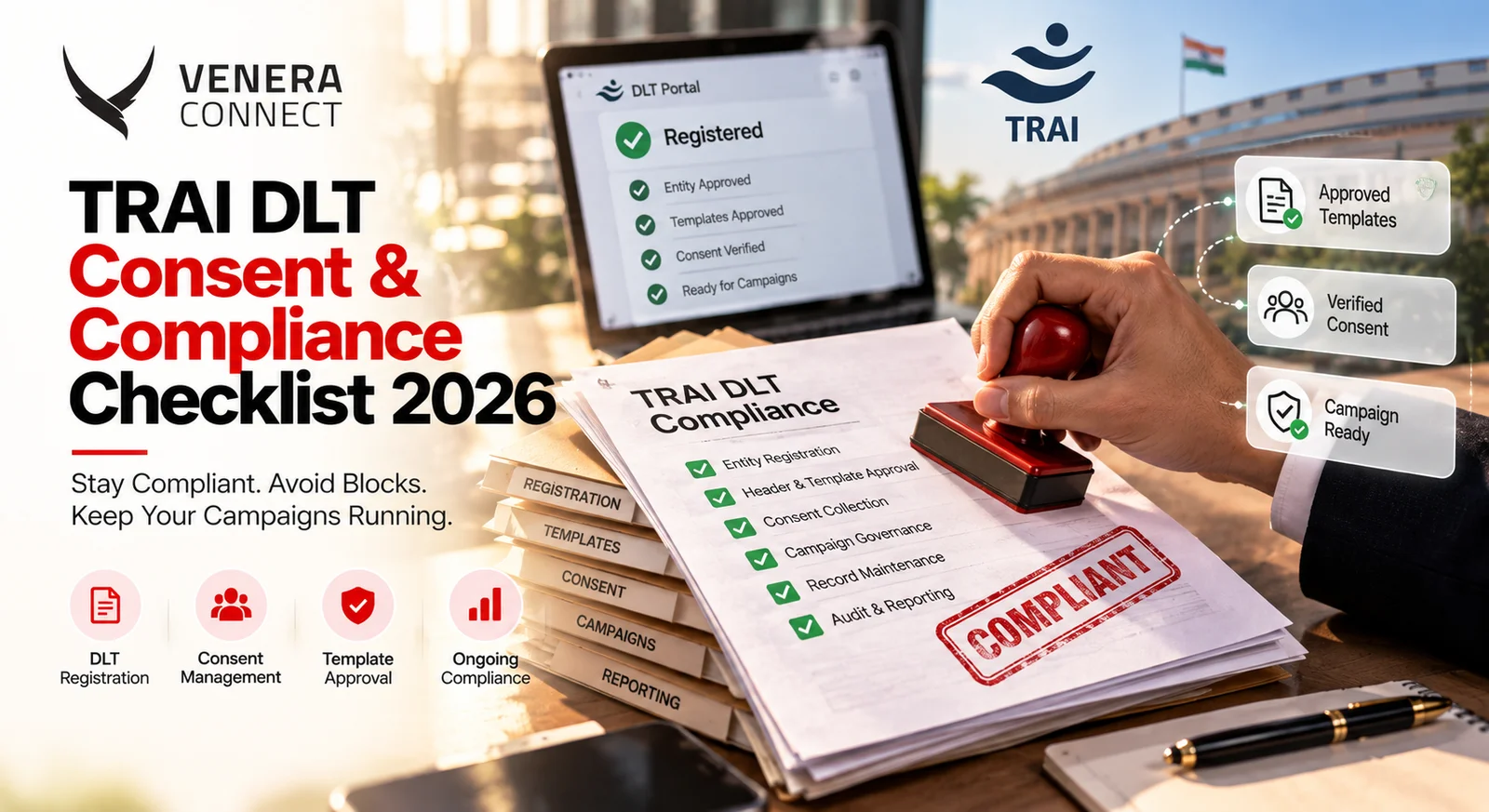
Any business sending commercial SMS in India operates inside a regulatory framework that has grown much stricter over the past few years — Distributed Ledger Technology (DLT) registration, sender ID and template approval, and increasingly specific consent and disclosure requirements. None of this is optional, and non-compliance doesn’t just risk fines — it can mean operators block messages entirely before they reach a customer. This guide breaks TRAI DLT compliance down into a practical checklist your team can follow.
Why the TRAI DLT Compliance Framework Exists
TRAI built its DLT system to tackle exactly the kind of abuse that has made SMS a target for fraud and spam — unregistered senders blasting unsolicited messages, fraudulent OTPs, and impersonation of legitimate businesses. As a result, the framework requires businesses to register every commercial sender, template, and consent record and keep them traceable, giving telecom operators the ability to block non-compliant traffic before it reaches a customer’s phone.
The Core TRAI DLT Compliance Checklist
Register as a Principal Entity (PE) on the DLT platform. Every business sending commercial SMS needs to register on the relevant telecom operators’ DLT platforms and provide business KYC details.
Register every sender ID and secure approval. You must register the sender ID and secure approval, because operators can block messages from an unregistered sender ID outright.
Register every message template exactly as you plan to send it. Sending a message that doesn’t match an approved template is a common cause of delivery failures.
Maintain documented consent for promotional messages. Promotional messages require explicit customer consent, and you need to record that consent and keep it traceable.
Apply the correct message category and headers. Regulators treat transactional, service, and promotional messages differently, so using the wrong classification is a frequent compliance mistake.
Stay current on suffix and disclosure requirements. TRAI periodically updates specific formatting requirements that apply to all registered senders.
Respect DND (Do Not Disturb) preferences for promotional content. Customers on DND lists should not receive promotional messages unless they’ve specifically opted in.
Common Mistakes That Stop Messages Reaching Customers
Sending promotional content through a transactional template or sender ID. This is one of the most common violations, and it quickly leads operators to block your traffic.
Letting template registrations go stale. A slight wording change that doesn’t match the registered template can cause delivery failures at scale.
Treating consent as a one-time, permanent status. Businesses increasingly need to show when and how they captured consent.
Assuming compliance is “set and forget.” However, a registration that met the rules a year ago may not meet them today.
Building TRAI DLT Compliance Into Daily Operations
Assign clear ownership. Someone needs explicit ownership of keeping registrations current, since compliance often falls between marketing and IT/legal.
Work with a provider that enforces compliance at the platform level. A platform that validates templates against DLT registration before sending catches problems before they become blocked campaigns.
Review your active templates and sender IDs on a regular cadence. Not just at initial setup.
Keep consent records exportable and auditable. This protects the business if anyone ever questions consent.
For the source rules, visit the official TRAI website. If you want help registering headers and templates, explore our bulk SMS solution.
Frequently Asked Questions
What’s the difference between transactional and promotional SMS under DLT rules?
Transactional (and service) messages relate to a specific transaction or account action and don’t require promotional consent. Promotional messages are marketing content and require explicit, documented consent plus respect for DND registration.
What happens if I register my SMS template incorrectly?
Telecom operators can block messages that don’t match an approved template before they reach the customer. As a result, the business pays for a send that never arrives.
Does DLT registration apply to WhatsApp and RCS too, or only SMS?
DLT registration specifically applies to SMS. WhatsApp and RCS have their own separate verification and business registration requirements.
How often do TRAI’s rules change?
TRAI has updated the framework multiple times in recent years, including changes to message suffixes and disclosure requirements — which is why periodic compliance review matters.
Staying compliant across DLT registration, template approval, and consent tracking is easier with a messaging platform that enforces the rules at send time rather than leaving it to manual review. Venera Connect can audit your current SMS setup against the latest TRAI requirements.