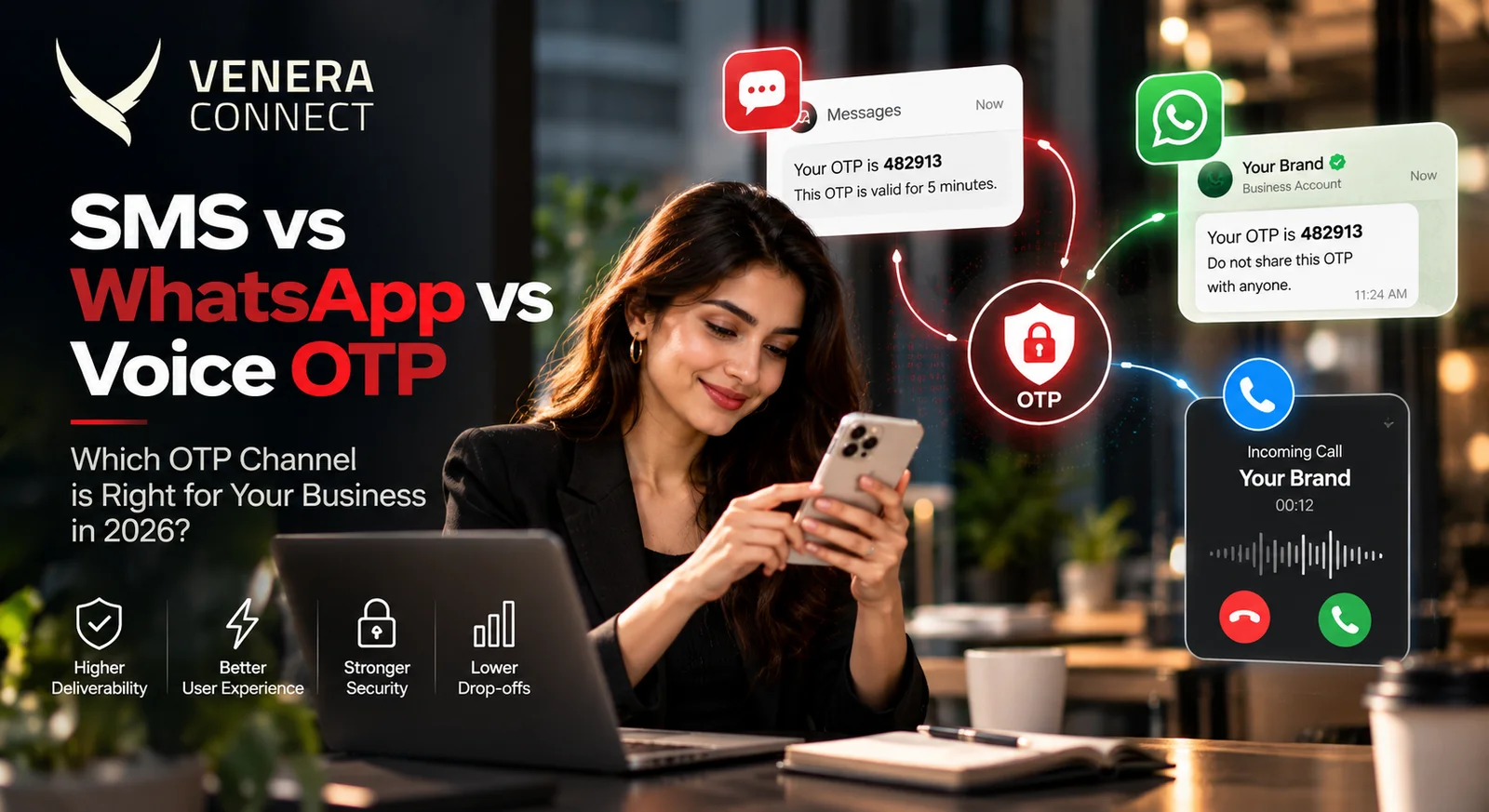
Almost every login, checkout, and password reset flow in India runs through some form of OTP. What’s less obvious is that “send an OTP” isn’t a single decision. SMS, WhatsApp, and voice calls each deliver that one-time code differently, with real trade-offs in reliability, cost, and user experience. Choosing between SMS, WhatsApp OTP and voice codes affects cost, speed and conversion.
SMS, WhatsApp OTP and Voice OTP Compared
SMS OTP is the universal default — it reaches every mobile number on every network, with no app or opt-in required. It’s the most reliable fallback precisely because it depends on the least.
WhatsApp OTP delivers the code inside a WhatsApp conversation, often with richer formatting and a recognizable, verified business sender. It requires the customer to have WhatsApp installed and, in most implementations, an existing opted-in relationship.
Voice OTP delivers the code as a spoken message during a phone call. It’s particularly valuable for accessibility and for landline numbers, which can’t receive SMS or WhatsApp at all.
Where SMS, WhatsApp OTP and Voice Each Win
SMS wins on universal reach. If you only get to pick one channel and need it to work for every customer regardless of device, app, or internet connectivity, SMS remains the safest default.
WhatsApp wins on trust and experience for opted-in users. A verified WhatsApp sender delivering an OTP inside an existing conversation feels more trustworthy than an SMS from an unrecognized short code.
Voice wins on accessibility and edge cases. Landline numbers, users with visual impairments, and unreliable SMS delivery are exactly where voice OTP earns its place.
Why Relying on Only One Channel Is a Mistake
Delivery isn’t always instant or guaranteed on any single channel. A business with no fallback loses customers at the very moment they’re most motivated to buy.
Not every customer is reachable the same way. Some customers don’t have WhatsApp; some numbers are landlines. A single-channel OTP strategy silently excludes whichever slice of customers that channel doesn’t reach well.
Fraud exposure differs by channel. Open SMS endpoints are a common target for OTP abuse. Channels that require an existing opt-in relationship are inherently harder to exploit at scale.
A Practical Framework for Choosing SMS vs WhatsApp OTP
Default to SMS for first-time or unknown users, since it requires no prior relationship and reaches the widest possible audience.
Offer WhatsApp OTP as the primary channel once a customer has an existing opt-in relationship, while still keeping SMS as an automatic fallback.
Use voice OTP as a fallback trigger, automatically offered when SMS delivery fails or the number on file is a landline.
Set a delivery timeout and automatic fallback sequence, so a customer who doesn’t receive an SMS within a defined window is automatically offered a voice call.
Apply the same fraud safeguards regardless of channel. Rate limiting, number validation, and spend monitoring matter whether the OTP goes out over SMS, WhatsApp, or voice.
Explore our SMS OTP service for reliable delivery, and check the TRAI rules for transactional messages in India.
Frequently Asked Questions
Which OTP channel has the highest delivery success rate?
SMS generally has the broadest reach, but actual delivery reliability varies by network, region, and time. That is exactly why a fallback sequence across channels outperforms relying on any single one.
Is WhatsApp OTP more secure than SMS OTP?
WhatsApp’s requirement for an existing opt-in relationship makes it somewhat harder to exploit for bulk fraud, but neither channel is inherently immune to abuse.
When should a business use voice OTP instead of SMS or WhatsApp?
Primarily as a fallback — when SMS delivery fails or times out, when the number is a landline, or when a customer needs accessibility support.
Does using multiple OTP channels increase cost significantly?
Using a fallback sequence typically adds cost only for the smaller share of customers whose first channel fails. That is far cheaper than the lost conversions from customers who never receive their code.
A layered OTP strategy — SMS first, with automatic WhatsApp or voice fallback — catches the customers a single channel would silently lose. Venera Connect’s verification APIs handle that fallback logic automatically, so you don’t have to build and maintain it yourself.