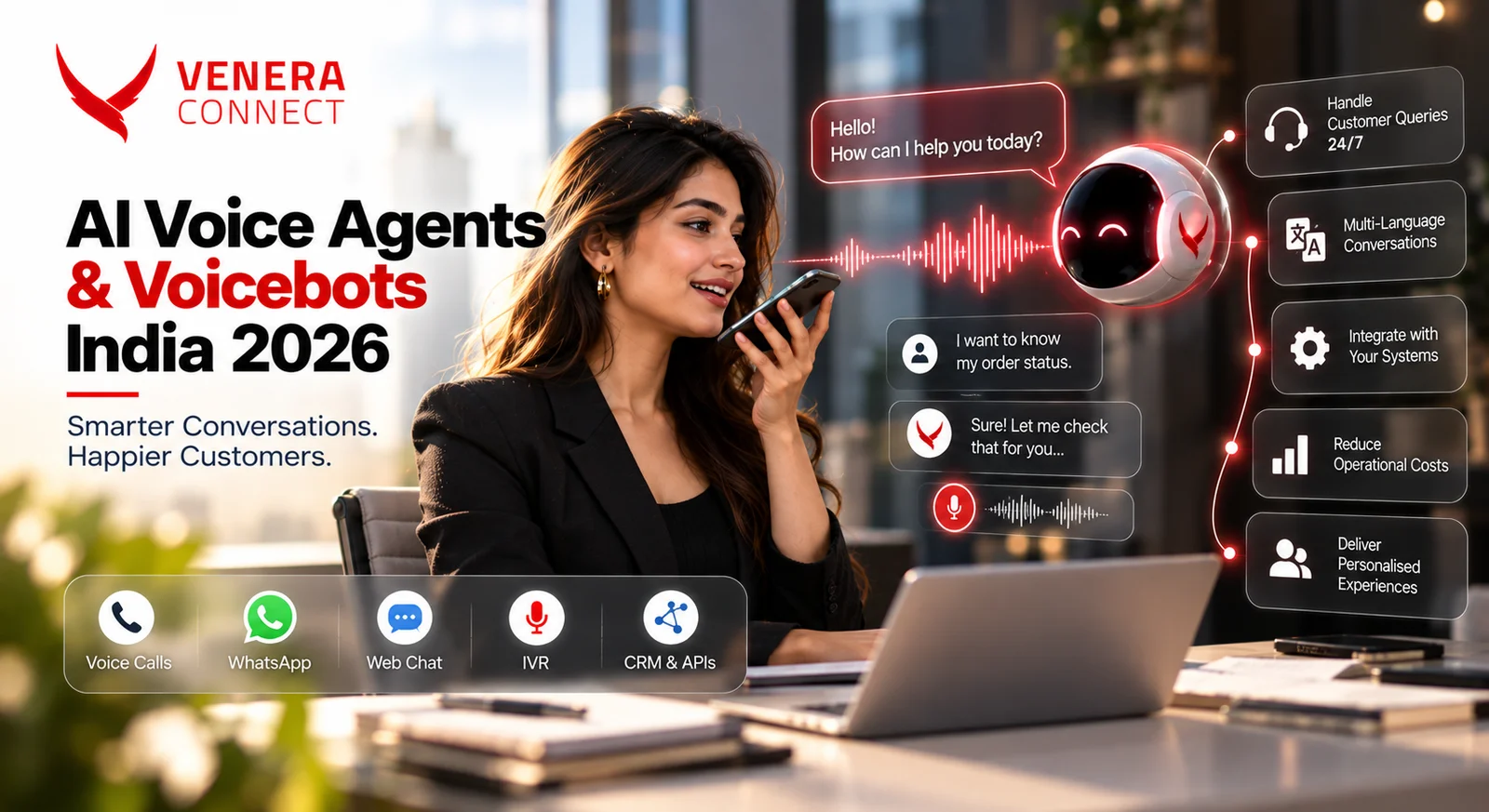
Interactive Voice Response (IVR) has always had a reputation problem — “press 1 for sales, press 2 for support” menus that trap customers in loops before they ever reach a real answer. AI voice agents are a genuinely different technology: instead of navigating a fixed menu tree, a customer speaks naturally, and the system understands intent, holds a real conversation, pulls information from business systems in real time, and either resolves the query directly or hands off to a human with full context.
What Changed: From Menu Trees to Conversation
Traditional IVR, however, runs on rigid decision trees. AI voice agents use speech recognition and language understanding to interpret what a customer actually says, in natural sentences, not a predefined menu choice. A customer can say “I want to check when my order from last week is arriving” in one sentence, and the system understands the intent, extracts the relevant detail, and looks it up — no menu navigation required.
What AI Voice Agents Handle Well Today
Order status and account information lookups. Structured queries against a business’s own systems are exactly the kind of high-volume, repetitive, well-defined queries voice agents handle reliably.
Appointment scheduling and rescheduling. For example, a voice agent can check availability, offer slots, and confirm a booking in a natural back-and-forth.
First-line triage and routing. Understanding why a customer is calling and routing them to the right team with context already captured.
Multilingual support at scale. Teams can build voice agents that handle multiple Indian languages, addressing a gap that plagued English-only IVR systems for years.
After-hours and overflow handling. Answering calls a human team can’t get to immediately, without customers hitting voicemail or a busy signal.
Where Human Agents Still Matter
Emotionally charged or high-stakes conversations. A complaint about a damaged product or a sensitive billing dispute benefits from human judgment and empathy current voice AI can’t fully replicate.
Genuinely novel or ambiguous requests. A request outside what the system was built to handle should escalate cleanly to a human.
Negotiation and judgment calls. A refund exception or a custom pricing conversation is still better handled by a person empowered to make that call.
Building trust in new or high-consideration relationships. For a first-time, high-value interaction, a human voice often still carries more reassurance.
How to Deploy AI Voice Agents That Actually Work
Start with a narrow, well-defined scope. The most successful deployments handle a specific, high-volume query type extremely well.
Also, build explicit, fast escalation to a human. In addition, the handoff should be immediate and carry full conversation context.
Measure containment and satisfaction together, not containment alone. A voice agent that resolves 80% of calls but leaves customers frustrated isn’t actually succeeding.
Train and test in the actual languages and accents your customers use. Testing across the actual linguistic diversity of your customer base matters more than it does for text-based channels.
Keep a visible, easy path to a human at every step. A clear, fast way to reach a person builds trust in the AI system itself.
Explore our voice solutions, or read the background on interactive voice response to see how far the technology has come.
Frequently Asked Questions
Can AI voice agents handle Indian regional languages?
Increasingly, yes — modern voice AI systems support multiple Indian languages, though quality varies by language and accent, so it’s worth testing specifically against your actual customer base.
Will an AI voice agent replace my human support team?
For most businesses, no — the most effective deployments use voice agents to handle high-volume, repetitive queries, freeing human agents to focus on complex or high-value conversations.
How is an AI voice agent different from the IVR menus I already have?
Traditional IVR requires customers to navigate a fixed menu tree. AI voice agents understand natural, conversational speech and can handle a much wider range of phrasing without forcing the customer down a rigid path.
What happens if a voice agent doesn’t understand a customer?
A well-built system recognizes low confidence and escalates to a human agent automatically, passing along whatever context was already gathered.
Voice agents work best when they’re built around your actual call volume and query patterns, not a generic template. Venera Connect can help map which of your call types are good candidates for AI handling versus which should stay with your human team.