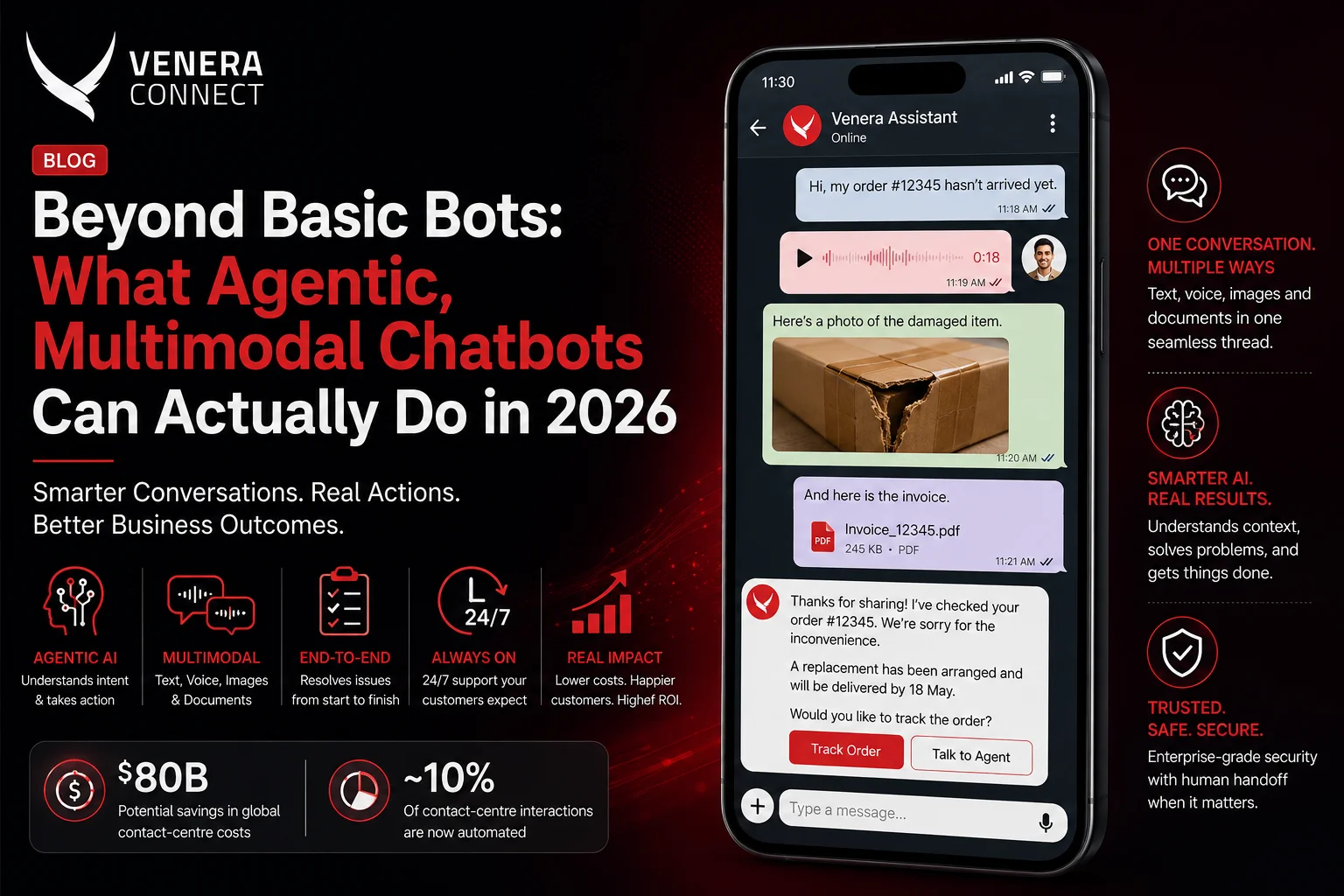
Most people still think of agentic AI chatbots the way they worked a few years back. Picture a menu of canned buttons, or a text box that replies “Sorry, I didn’t understand that. Please rephrase.” That version of the chatbot earned its bad reputation honestly. It’s also almost extinct in 2026.
What’s replaced it looks and behaves less like a scripted FAQ page and more like an actual support agent. Today’s agentic AI chatbots understand what a customer means. They remember what the customer said earlier in the conversation, and they now handle far more than plain text.
From Scripted Bots to Agentic AI Chatbots
Old-style chatbots worked on keyword matching. Phrase your question slightly wrong, and the bot had no idea what to do with you. Today’s conversational AI works on intent. A customer can describe a problem however they naturally would. They might say, “My order hasn’t shown up and it’s been a week,” instead of hunting for a menu option. The bot understands the underlying request, pulls the relevant order data, and takes the next step itself.
This is what “agentic” means in practice: the bot doesn’t just answer a question — it completes a multi-step task. That might mean checking an order, applying a discount, booking a slot, or updating a delivery address. It does all of that the same way a live agent would, without a human needing to step in.
The Business Case Isn’t Subtle
The numbers behind the shift toward agentic AI chatbots are hard to ignore. This year’s projections put the potential savings from conversational AI on global contact-centre labor costs at around $80 billion. That’s because these bots now handle the routine volume on their own — order status checks, account questions, basic troubleshooting. Just a few years ago, automation covered under 2% of contact-centre interactions. Industry estimates now put that figure closer to one in ten, and climbing.
Cost is the other half of the story. A human-handled support interaction typically runs into several dollars once you account for time and overhead; an AI-handled interaction on the same routine query typically costs a small fraction of that. That gap is a big part of why the global chatbot market — worth just a few billion dollars a couple of years ago — is now on track to roughly triple in size by the end of the decade.
What “Multimodal” Actually Looks Like
The bigger shift isn’t just cost. It’s capability. Older bots were text-only. A modern chatbot can now handle a voice note, a photo, or a document in the exact same conversation thread as a typed message, and reason across all of it together.
In practice, that means a customer can:
- Send a photo of a damaged product instead of typing out a description of the defect
- Leave a voice note describing an issue instead of typing it
- Share a PDF invoice or receipt to resolve a billing question
- Do all of this in one continuous thread, without repeating themselves to a different agent or channel each time
That last point matters more than it sounds. One of the most common complaints with traditional support is having to explain the same problem over and over to different people. A bot that can see the whole conversation, text, image, voice, and document together, and act on it directly removes that friction.
Customers Are More Ready for This Than You’d Think — With One Caveat
Recent consumer surveys show a real shift in expectations: a growing share of customers now expect round-the-clock support as the baseline, not a bonus, and a majority believe bots are close to holding genuinely natural conversations, if they aren’t there already.
That said, it isn’t a wholesale replacement story. Surveys consistently find that a solid majority of customers still want a human option for anything complicated, high-stakes, or emotionally charged. A disputed charge, a serious complaint, a sensitive account issue. The smartest deployments treat the bot as the fast lane for everything routine, with a clean, fast handoff to a human the moment a conversation needs one. That combination, not a bot trying to do everything, is what actually earns customer trust.
What You Can Actually Build With Agentic AI Chatbots
A well-built chatbot today goes far beyond answering FAQs. Businesses are using them to:
- Automate everyday processes — order tracking, personalized product recommendations, and request routing, without a human touching every ticket
- Run offers and loyalty programs — serving tailored promotions based on a customer’s buying history and loyalty status, and letting them manage or redeem rewards right in the chat
- Power referral programs — letting customers share referral codes and get rewarded automatically for successful referrals
- Handle post-purchase support — returns, exchanges, refund status, warranty activation, and repair requests, without a support ticket queue
- Drive geo-targeted marketing — using a customer’s location to support store discovery, share directions, and deliver location-based promotions
- Share rich product information — specs, brochures, and stock or inventory updates for higher-consideration purchases, including accepting advance orders when something’s out of stock
- Collect feedback — running quick surveys and polls to capture customer sentiment at the moment it matters
- Guide customers inside physical stores — in-store navigation and floorplan guidance for larger retail spaces
And because a chatbot doesn’t have to live on just one channel, the same bot can meet customers wherever they already are, SMS, WhatsApp, or your website, instead of forcing them into a separate app or portal.
Getting Started With Agentic AI Chatbots
Deploying a chatbot that actually helps, instead of frustrating people, comes down to a few fundamentals:
- Train it on your real data. Your actual FAQs, order and product data, and past support conversations, not a generic script.
- Design the handoff, not just the bot — decide upfront exactly when and how a conversation escalates to a human, so customers never feel stuck.
- Meet customers on their channel of choice — SMS, WhatsApp, and web all behave differently, and the experience should feel native to each one.
Where Venera Connect Fits In
This is exactly what Venera Connect’s Chatbot Solution is built around: agentic AI chatbots that run across SMS, WhatsApp, and web, designed to actually complete tasks — process automation, personalized offers, loyalty and referral programs, post-purchase support, geo-targeted marketing, product information, feedback collection, and even in-store navigation for larger retail spaces. Not just answer questions and stop there.
If your current chatbot (or lack of one) is still stuck answering three FAQs and giving up on everything else, 2026 is a reasonable year to fix that.
Curious what an AI chatbot could handle for your business? Get in touch with Venera Connect to get started.